Protecting health care for Californians experiencing homelessness.
The Stay Covered Toolkit
The Stay Covered Toolkit will enable health, housing, and homeless services providers to help people experiencing or at risk of homelessness get and keep their Medi-Cal.
It includes an overview of the new H.R.1 rules and how it will impact Medi-Cal coverage for people experiencing homelessness; tools for health, housing, and homeless services providers to use when interacting with their clients and patients; and actions that different types of providers can take to help unhoused members stay covered.
About the Stay Covered Coalition
The Stay Covered Coalition formed in 2026 to address unprecedented threats to Medicaid coverage for Californians experiencing homelessness.
What you can expect from us:
Practical resources that help organizations support people experiencing homelessness in maintaining Medicaid coverage.
Convening partners and learning spaces across health care, housing, homelessness, and government systems to share best practices.
Advancing policy and operational practices to reduce avoidable coverage losses and strengthen access to care.

Upcoming
Stay Covered Toolkit Launch Webinar Series
The Stay Covered Coalition is hosting a two-part webinar series to launch the upcoming Stay Covered Toolkit, a California-specific resource to help organizations support Californians experiencing homelessness in keeping their Medi-Cal.
Webinar 1: November 12 @9am PT
An introduction to the Stay Covered Coalition toolkit and how to use it. We'll cover the basics of what is changing and why it matters for people experiencing homelessness, and show you the tools and resources available to you.Webinar 2: December 3 @11:30am PST
A deeper dive into new work and community engagement requirements and medical frailty exemptions. We'll look at who must meet the requirements, who may be excused, and how to help clients document it.
Who should attend: Homeless service providers, health care providers, street medicine providers, CoC staff, health plans, and anyone else who helps people with their Medi-Cal.
Recordings and slides will be made available here after each webinar.

Resources from the Coalition
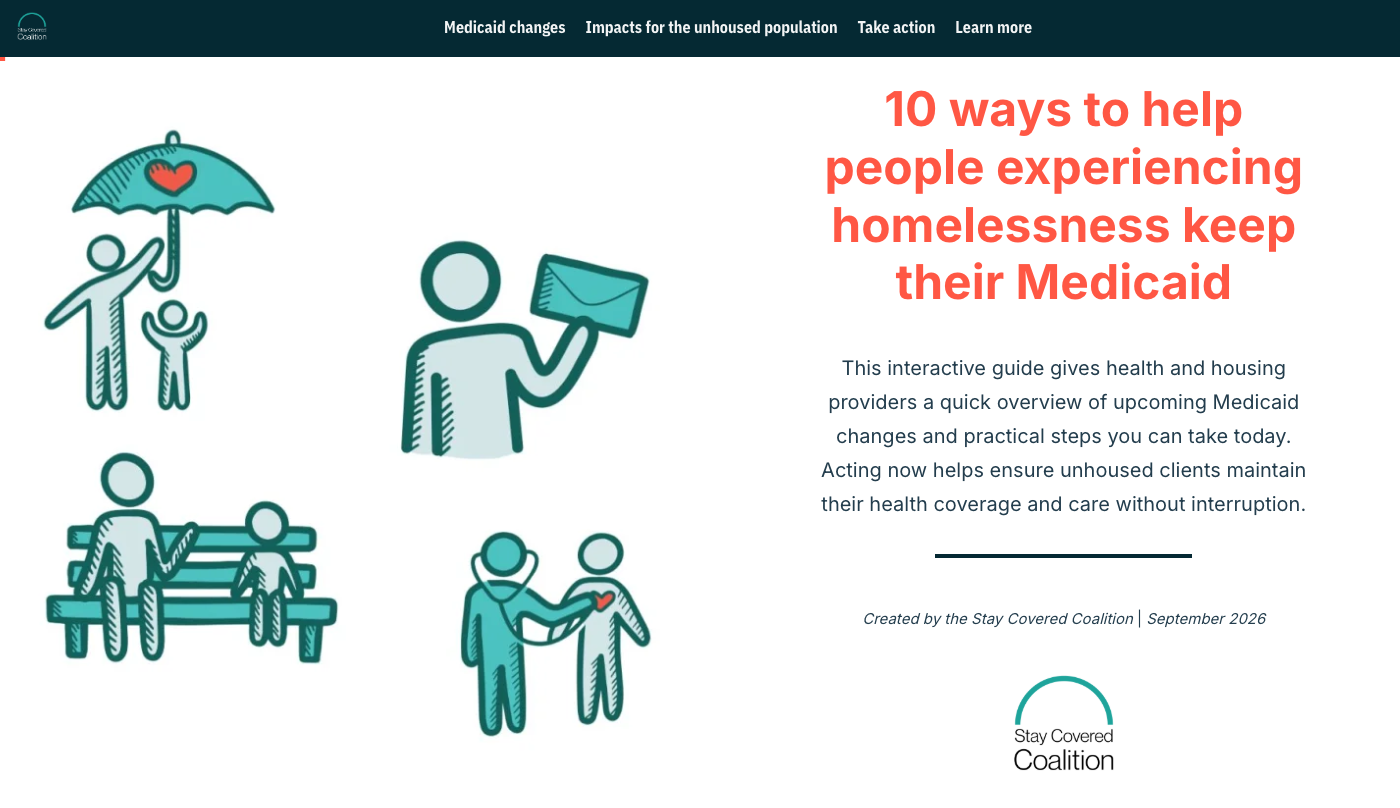
10 Ways to Help People Experiencing Homelessness Keep Their Medicaid
This interactive page developed with the Stay Covered Coalition gives health and housing providers a quick overview of upcoming Medicaid changes and practical steps you can take today. Acting now helps ensure unhoused clients maintain their health coverage and care without interruption.
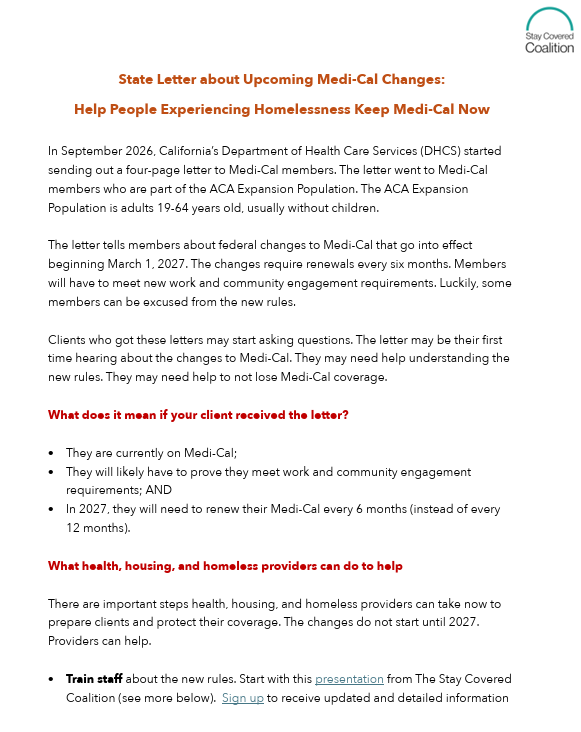
State Letter about Upcoming Medi-Cal Changes: Help People Experiencing Homelessness Keep Medi-Cal Now
In September 2026, California’s Department of Health Care Services (DHCS) started sending out a letter to Medi-Cal members. The letter tells members about federal changes to Medi-Cal that go into effect beginning March 1, 2027. They may need help to not lose Medi-Cal coverage. This document includes useful information for providers to help these clients navigate the changes and maintain coverage.
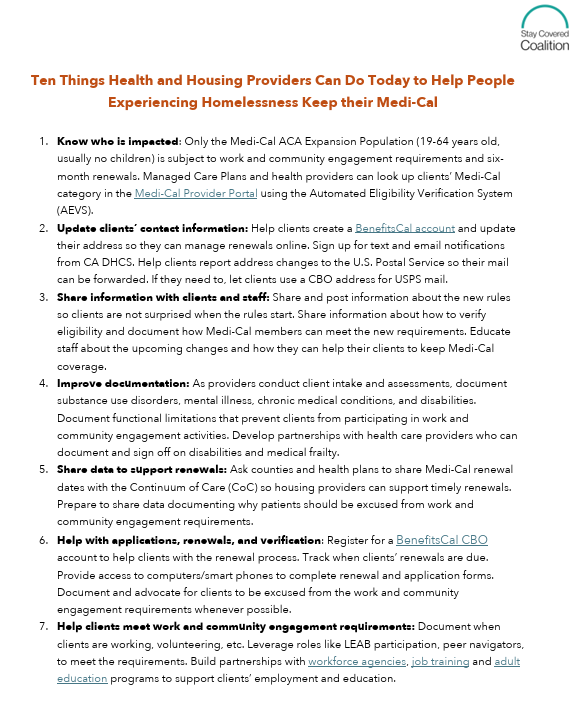
Ten Things Health and Housing Providers Can Do Today to Help People Experiencing Homelessness Keep their Medi-Cal
As 2025 H.R.1 changes put Medicaid coverage at risk, it’s important for health and housing providers to know what they can do to protect coverage for people experiencing homelessness. This document lays out the top ten things providers can do today.
Overview of Centers for Medicare & Medicaid Services (CMS) Guidance and Implications
This presentation outlines major Medicaid changes resulting from recently released CMS guidance related to H.R.1, including new work requirements and more frequent eligibility renewals. It also highlights the unique impacts these changes may have on people experiencing homelessness and the homeless response systems that support them.
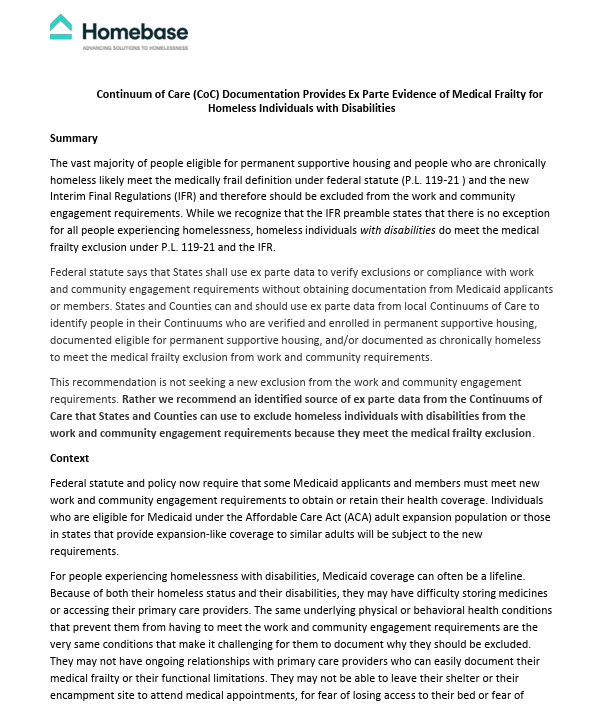
Continuum of Care (CoC) Documentation Provides Ex Parte Evidence of Medical Frailty for Homeless Individuals with Disabilities
Federal statute says that States shall use ex parte data to verify exclusions or compliance with work and community engagement requirements without obtaining documentation from Medicaid applicants or members. States and counties can and should use ex parte data from local CoCs to identify people in their Continuums who can meet the medical frailty exclusion from work and community requirements.
Join us every month for office hours.
The Stay Covered Coalition hosts virtual office hours on the second Wednesday of each month from 11:00 a.m.–12:00 p.m. PT. These sessions provide a peer learning space to discuss the implementation of Medicaid changes, share strategies and resources, and explore how we can support Californians experiencing homelessness in getting enrolled and staying covered.
Don’t miss an update.
Sign up to receive practical tools, resources, and strategy updates from the Coalition.
To contact the coalition, please email: staycovered@homebaseccc.org

Additional resources and information
The following are practical resources and information from Coalition partners and other sources.
Updated Medicaid Work Reporting Requirements: Summary & Actions (National Health Care for the Homeless Council)
Letter to states with work requirement recommendations (National Health Care for the Homeless Council)
Internal Strategies to Prepare for Medicaid Work Reporting Requirements (National Health Care for the Homeless Council)
Medicaid “Community Engagement” Compliance Checklist (National Health Care for the Homeless Council)
More About the Coalition
2025 H.R.1 Medicaid changes included community engagement requirements known as “work requirements” and more frequent redetermination processes. The regulations will create particular challenges for people experiencing homelessness, who often face barriers to receiving mail, maintaining documentation, accessing technology, and responding quickly to eligibility notices. Given the high rates of complex health and social needs in this population, Medicaid coverage is vital for continued access to health care, behavioral health services, substance use treatment, and housing-related services.
The Coalition will draw on the knowledge, relationships, and constituencies of its member organizations and partners to build a more coordinated policy and community response to the upcoming Medicaid changes. Over the next two years, the Coalition will share tools and best practices with state and local partners and providers to support efforts that help unhoused Californians maintain coverage.
The Coalition is funded by the California Health Care Foundation and CommonSpirit Health, and brings together the California Street Medicine Collaborative (CSMC), Corporation for Supportive Housing (CSH), Homebase, Klurfeld Consulting, and the National Health Care for the Homeless Council (NHCHC) to prevent unhoused Californians from losing Medicaid. The Center for Health Care Strategies serves as a collaborating partner to the Coalition. Read more about our partners below.
California Street Medicine Collaborative
The California Street Medicine Collaborative (CSMC) is a statewide learning, policy, and practice network of 1,000+ members, including 275+ organizational members, 80+ street medicine teams, and 21+ health plans across 35 counties, working together to strengthen care for people experiencing unsheltered homelessness.
Corporation for Supportive Housing
Since our founding in 1991, CSH has advanced affordable and accessible housing aligned with services by advocating for effective policies and funding, investing in communities, and strengthening the supportive housing field. As an intermediary, we center our approach on collaboration with a wide range of people, partners, and sectors.
Homebase
Homebase is a mission-driven nonprofit organization dedicated to building community capacity to end homelessness, reduce poverty, and foster thriving communities.
Klurfeld Consulting
Alison Klurfeld (Klurfeld Consulting, LLC) is an independent consultant who helps organizations integrate health and housing programs.
National Health Care for the Homeless Council
Grounded in human rights and social justice, National Health Care for the Homeless Council’s (NHCHC’s) mission is to build an equitable, high-quality health care system through training, research, and advocacy in the movement to end homelessness.